Studio
What's in my bag in 2026
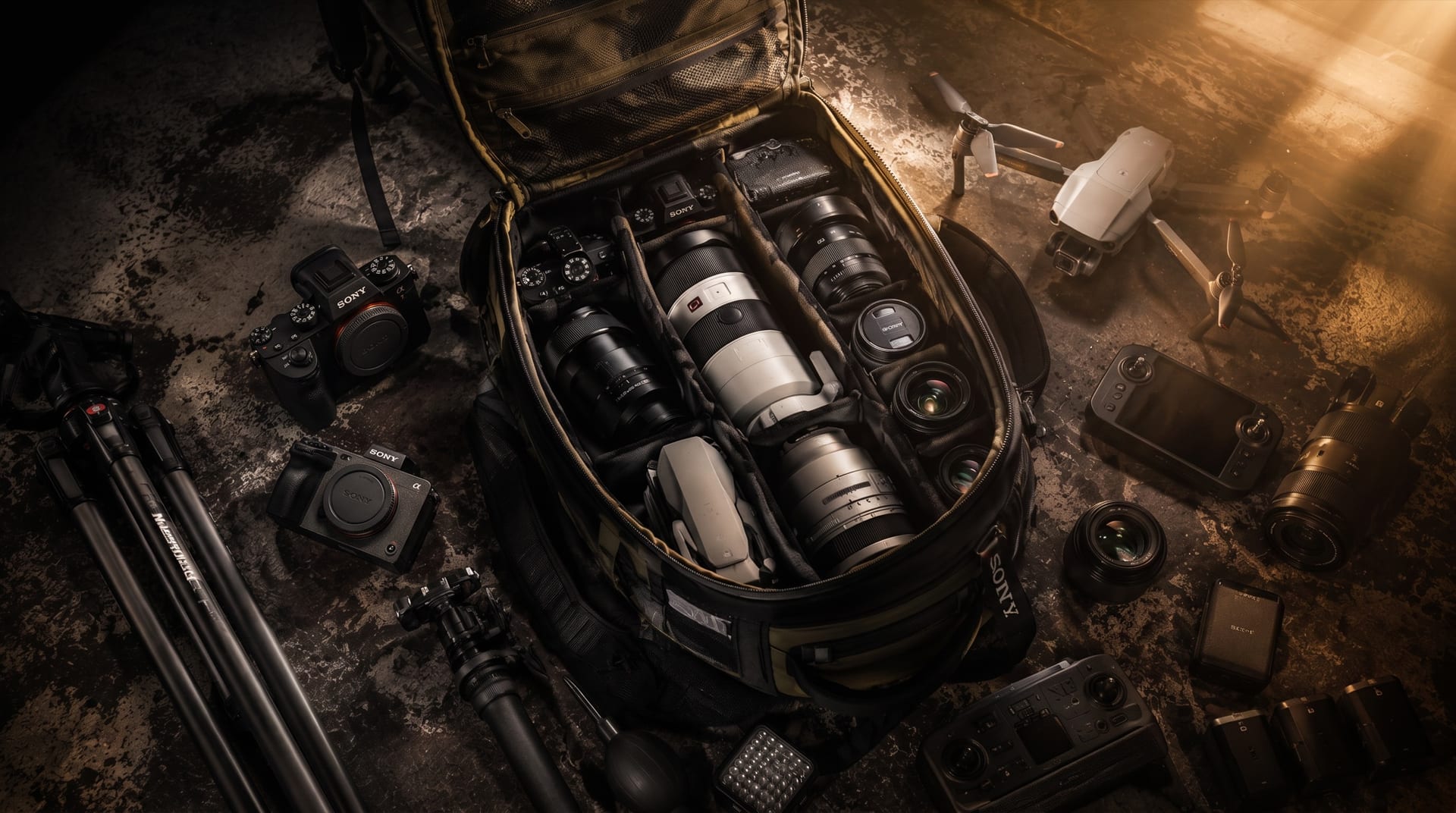
People often ask what I carry in my bag. The list isn't minimalist — it's distributed. Every tool in it does something the others don't. When I add something, I don't ask "do I want it" — I ask "what in the current bag can't do this."
The two bodies have different jobs. The Sony A7R V is the stills camera — 61 megapixels, precise focus, a workhorse for everything from weddings to interiors and fashion. The Sony FX3 is the cinema body — full-frame video, ideal for clients who want both photos and a short film from the day. Not "main and backup" — two tools for two different roles.
The lenses are four, split between extremes and ranges. The 35mm f/1.4 GM is the storytelling lens — wide but not distorting, my primary on a wedding day. The 85mm f/1.4 GM is for portraits and intimate frames, with depth of field that isolates the subject from the room. Those are the two primes.
The two zooms fill what primes can't reach. The 12-24mm f/2.8 GM is for interiors, for tight rooms, for moments when eleven men are getting dressed in a small space and I need to fit them all in. The 50-150mm f/2.0 GM is the long one — for ceremonies where I can't move closer, for guests from a distance, for moments I want to capture without anyone noticing I'm there.
The drones are two because they fly for different things. The DJI Mavic 4 is for classic aerial — landscapes, real estate, wedding locations from above, anything that wants smooth motion and wide perspective. The DJI Avata 360 is the FPV frame — fly-through between guests, scenes inside a room, things the Mavic simply can't do. When a couple wants "my photos to fly like in a movie," the Avata is the answer.
That's the whole bag. It weighs about 9 kg with batteries and chargers. Not minimal, but precise — every item has a specific job and I know what it is.
Why a hybrid setup instead of a pure prime-only kit?
First reason: the reality of a wedding. A wedding has moments you can control — portraits, frames in a prepared location — and moments you can't. When the father of the bride gives his speech from the floor, I can't walk three meters closer. With the 50-150 GM, I'm there without breaking him. Pure primes force me to accept compromise in those moments, and I refuse to compromise on a wedding.
Second reason: video changed everything. Four years ago I shot only stills. Now every third client also wants a short film — usually a 1-2 minute teaser for Instagram. With the FX3, I shoot the video on the same day, in the same light, with the same eye. That isn't an extra service — it's a single vision in two formats.
Third reason: the drones are different tools. The Mavic 4 gives me cinematic aerials — smooth sweeps, high views, mid-distance tracking. The Avata 360 gives me energy — an FPV burst through the wedding hall, a dive over the couple on the beach, something that feels like a participant rather than an observer. They aren't duplicates — they complement each other.
What's NOT in the bag:
Third stills camera. I have one, but it's studio-only. The two main bodies plus video cover everything.
Ring flash. Never. Ring flash light is flat, without character. Natural or continuous LED is always better.
Gimbal. The FX3 has excellent internal stabilization, and the Avata flies itself. I don't need a gimbal in the bag.
Long tele beyond 150mm. The 50-150 covers everything I shoot. I'm not a sports or wildlife photographer.
The principle:
Every item in the kit has to earn its presence. When I ask myself "do I need X?", the answer isn't "it would be nice." The answer is "what in the current bag can't do this." If there's no clear answer, X stays at home.
When I started in 2014, I carried 7 lenses and two bodies. It was a lot, because I didn't know what I actually used. Now I have fewer lenses, but more tools — and every one of them knows exactly why it's there.
Ready to plan?
See what the packages include and where the prices start.