Design
Discipline, focus, execution — why a photographer also designs
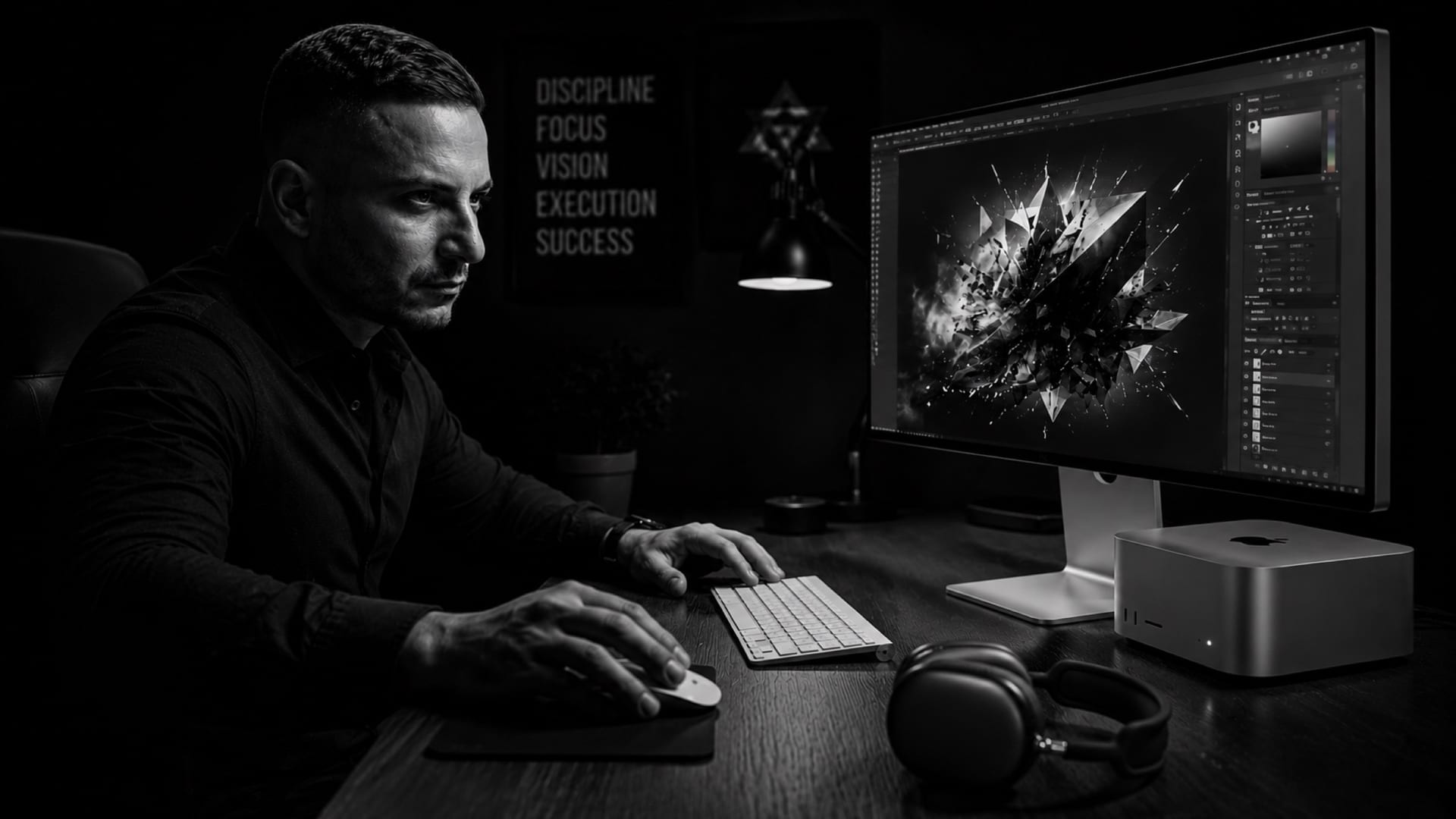
I've shot for 14 years. I've designed for 9. People often ask me how I do both — and whether one doesn't distract from the other. The truth is simpler: they feed each other.
On the studio wall I have five words: DISCIPLINE, FOCUS, VISION, EXECUTION, SUCCESS. They aren't motivational posters. They're a checklist for every project — photographic or graphic.
Discipline in design means not piling up. When I get a poster brief for BIZARRE — an exclusive premium building — the first impulse is to add: more copy, more colour, more graphics. The disciplined move is to remove. One clean render of the building, one name, one phone number, one logo. That's enough.

Focus is the same thing as in a photo: you know what matters and stay on it. When I design a billboard for Calma Bay, in the first five seconds before the driver passes by, they have to see one thing — the place's name and one atmospheric visual reference. Everything else is noise.

Vision is the wider picture. Who am I making this for? What should they feel when they see it? Calma Bay isn't a "hotel" — it's a "coastal restaurant with bright summer air." That defines the color palette, the typography, the photography.
Execution means doing it all the way through. A design project has 80% that lands in the first 4 hours and 20% that takes the next 12. That 20% is the difference between "acceptable" and "professional." Shadows, spacing, type details, the baseline grid. No client sees those consciously — all of them feel them.
Why does a photographer design? First: to control the outcome. I know how my photo will land on a billboard because I'm making the billboard itself. Second: to keep the style intact. I saw too many of my photos used in design by someone else — pasted into a standard Adobe template, with no understanding of what the frame meant. That's when I decided I'd make everything that travels with my photos.
The surprise for me — the reverse direction also works. After I started designing, I started shooting cleaner. When you compose a frame knowing that tomorrow it might be overlaid in a poster, you think about empty space. About negative zones where text could go. About contrast between subjects and background. That doesn't kill emotion — it amplifies it. Cleaner frames hold the eye more strongly.
When I get a new project — photo or design — I start with the same question: "What's the one thing that has to survive this?" If I can't answer in one sentence, I'm not ready to begin.
Ready to plan?
See what the packages include and where the prices start.